Flat Bottom Coffee Bag with One-Way Valve and Zipper (Custom Printed, 100 g – 1 kg)
Laminated Bags · 19浏览量
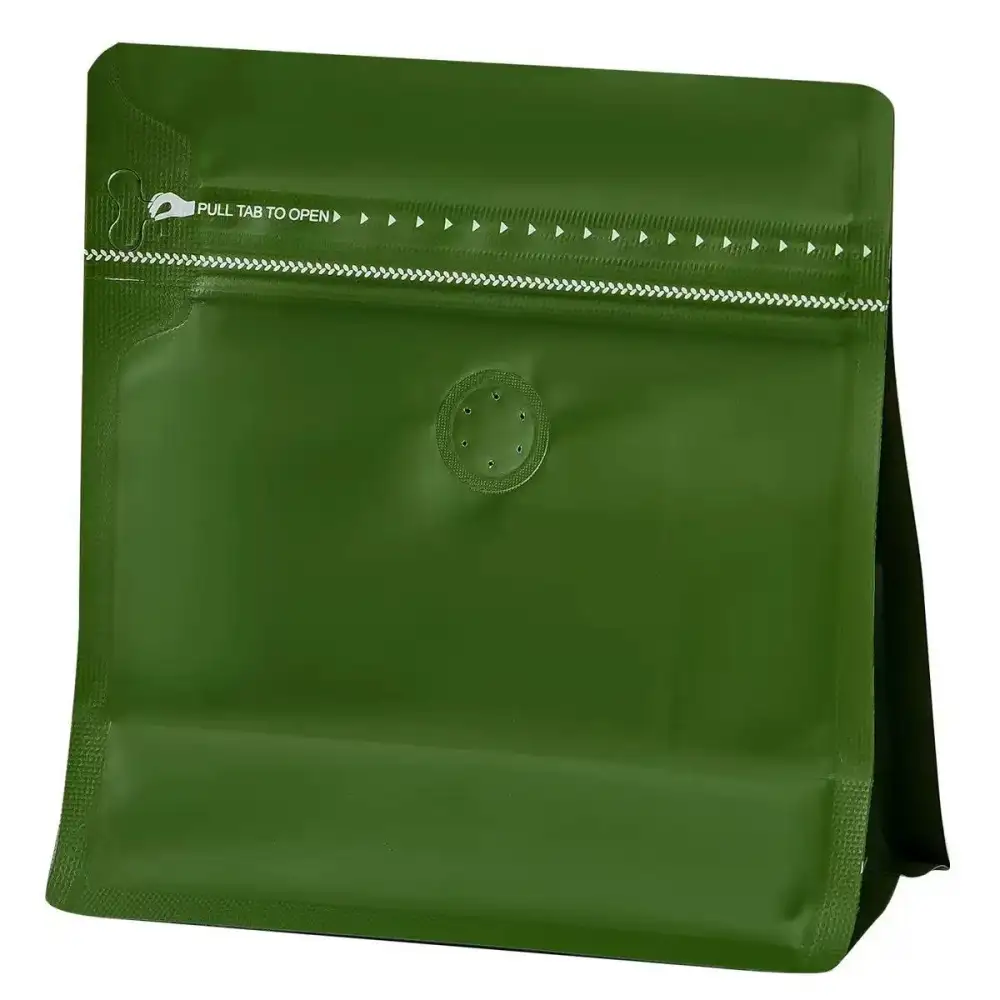
Laminated flat-bottom coffee pouch with a one-way exhaust valve that releases carbon dioxide and blocks oxygen, plus a press-to-close zipper, tear notch and sealed rear strip. Four reference sizes from 9 x 18 + 5 cm to 15 x 32.5 + 10 cm, with custom digital printing and 2-4 layer barrier options.
Product Details
A Coffee Bag That Lets the Beans Breathe
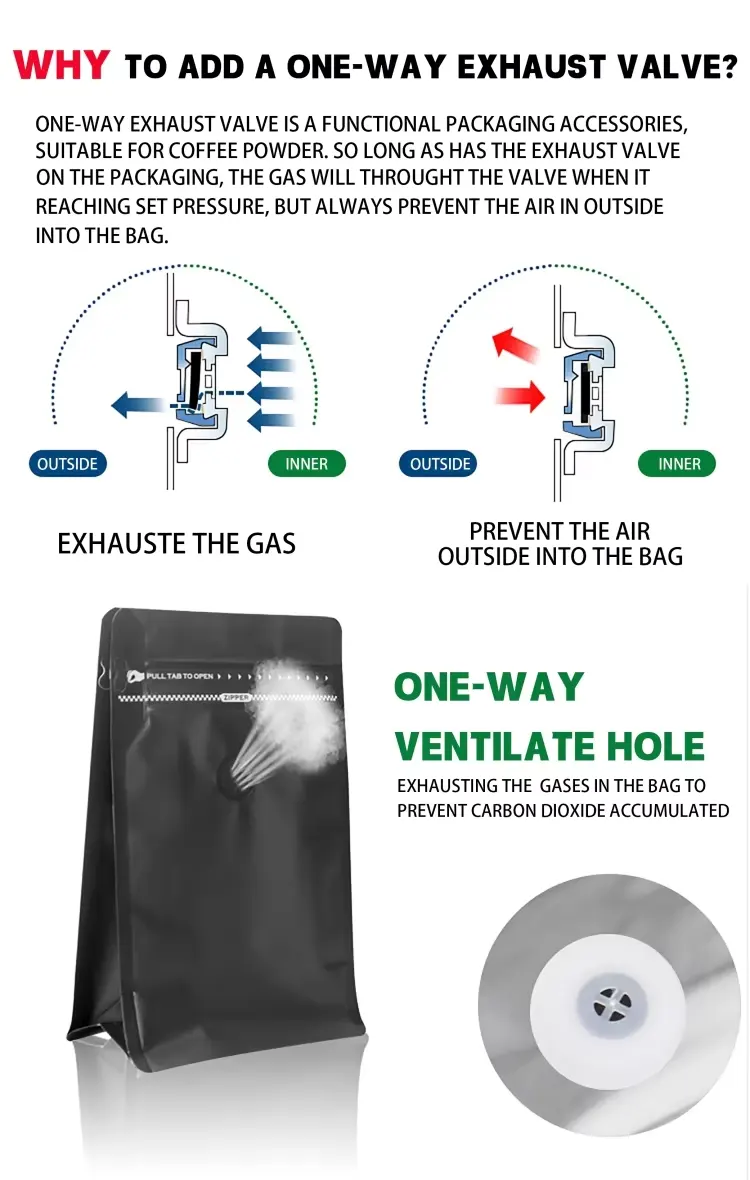
Roasted coffee keeps releasing carbon dioxide for days after the roast, and a sealed pouch with no outlet swells until the seam or the valve seat gives way. This flat-bottom bag carries a one-way exhaust valve on the front panel: gas escapes when the internal pressure rises, and outside air cannot get back in.
The bag body is a laminated flat-bottom pouch with a press-to-close zipper, a tear notch and pull-tab opening strip, and a sealed rear strip that can be heat sealed on a hand or continuous band sealer after filling.
How the One-Way Valve Works
The valve is a small functional accessory built into the front panel. When pressure inside the bag reaches the set point, the membrane lifts and the trapped carbon dioxide escapes; once the pressure equalises, the membrane closes and the same valve blocks oxygen and humidity from entering.
| Direction | Behaviour | Result |
|---|---|---|
| Inside to outside | Opens at the set pressure | Carbon dioxide is exhausted, no swelling or burst seam |
| Outside to inside | Stays closed | Oxygen, moisture and odours kept out |
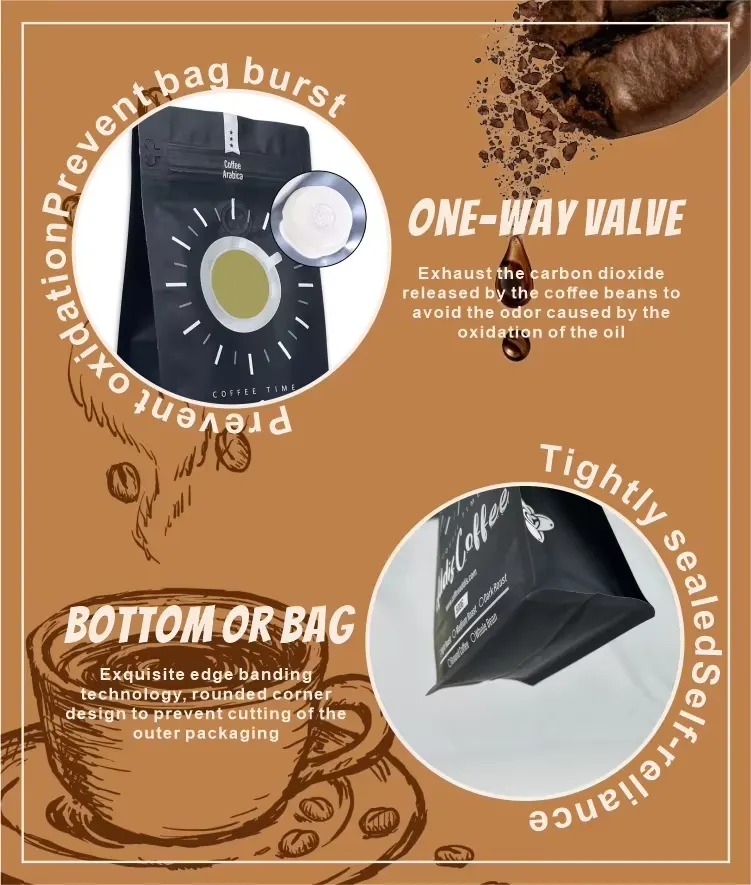
| Long storage | Continuous venting | Less oxidation of the coffee oils, aroma held longer |
That is why the valve is standard on coffee powder and whole-bean packs, and increasingly used on any product that degasses after packing.
Sizes and Fill Weights
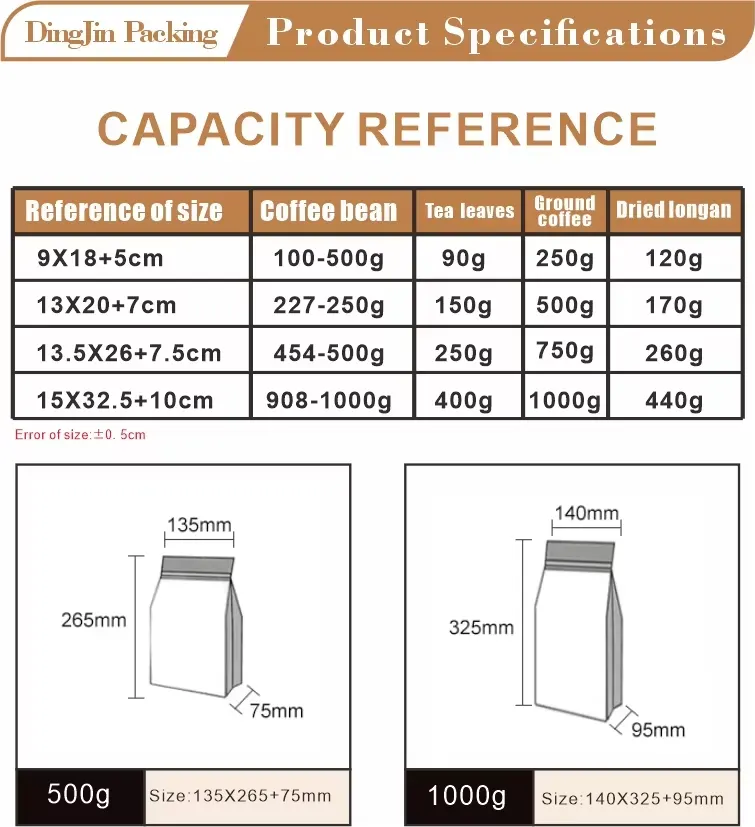
The range is quoted by the flat size plus the bottom gusset, and each size maps to a practical fill weight. The capacity table below is the reference we quote against; the two drawings at the end show the finished dimensions of the 500 g and 1,000 g bags.
| Reference size | Coffee beans | Tea leaves | Ground coffee | Dried longan |
|---|---|---|---|---|
| 9 × 18 + 5 cm | 100-500 g | 90 克 | 250 克 | 120 克 |
| 13 × 20 + 7 cm | 227-250 g | 150 克 | 500 克 | 170 克 |
| 13.5 × 26 + 7.5 cm | 454-500 g | 250 克 | 750 克 | 260 克 |
| 15 × 32.5 + 10 cm | 908-1000 g | 400 克 | 1000 克 | 440 克 |
Finished dimensions for two common formats: 135 × 265 + 75 mm for the 500 g bag and 140 × 325 + 95 mm for the 1,000 g bag. Size tolerance is ±0.5 cm.
Materials and Barrier Layers
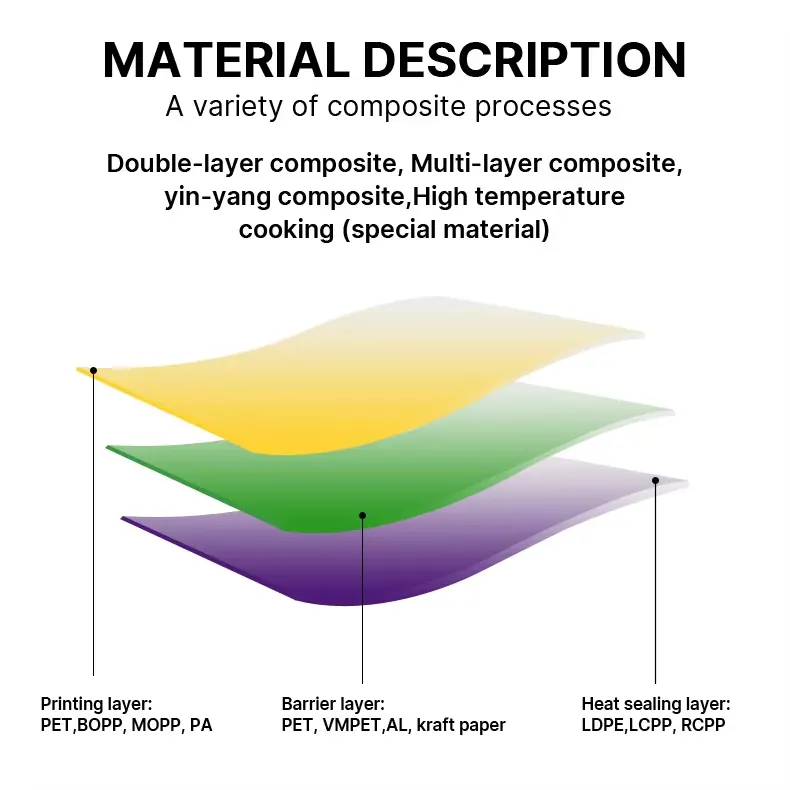
Every bag is a composite, and the combination is chosen against the shelf life the product needs. A two-layer structure covers short-cycle retail coffee; three layers add an aluminium or metallised barrier for longer freshness; four layers are used where the pack must hold aroma against heat and humidity.
| Layers | Conventional material matching | Typical use |
|---|---|---|
| 2 layers | OPP+CPP/PE, PET+CPP/PE, PA+CPP/PE | Short shelf life, cost-driven retail packs |
| 3 layers | OPP+PET+CPP/PE, PET+PET/AL/PA+CPP/PE | Standard coffee and tea packs with a barrier layer |
| 4 layers | PET+PA+AL+CPP | Long-life, high-barrier and export packs |
The construction is normally split into three jobs: a printing layer (PET, BOPP, MOPP or PA), a barrier layer (PET, VMPET, AL or kraft paper) and a heat-sealing layer (LDPE, LCPP or RCPP). The bag can also be built with an internal aluminium plating for a tighter oxygen block.
Zipper, Tear Notch and Finishing Options
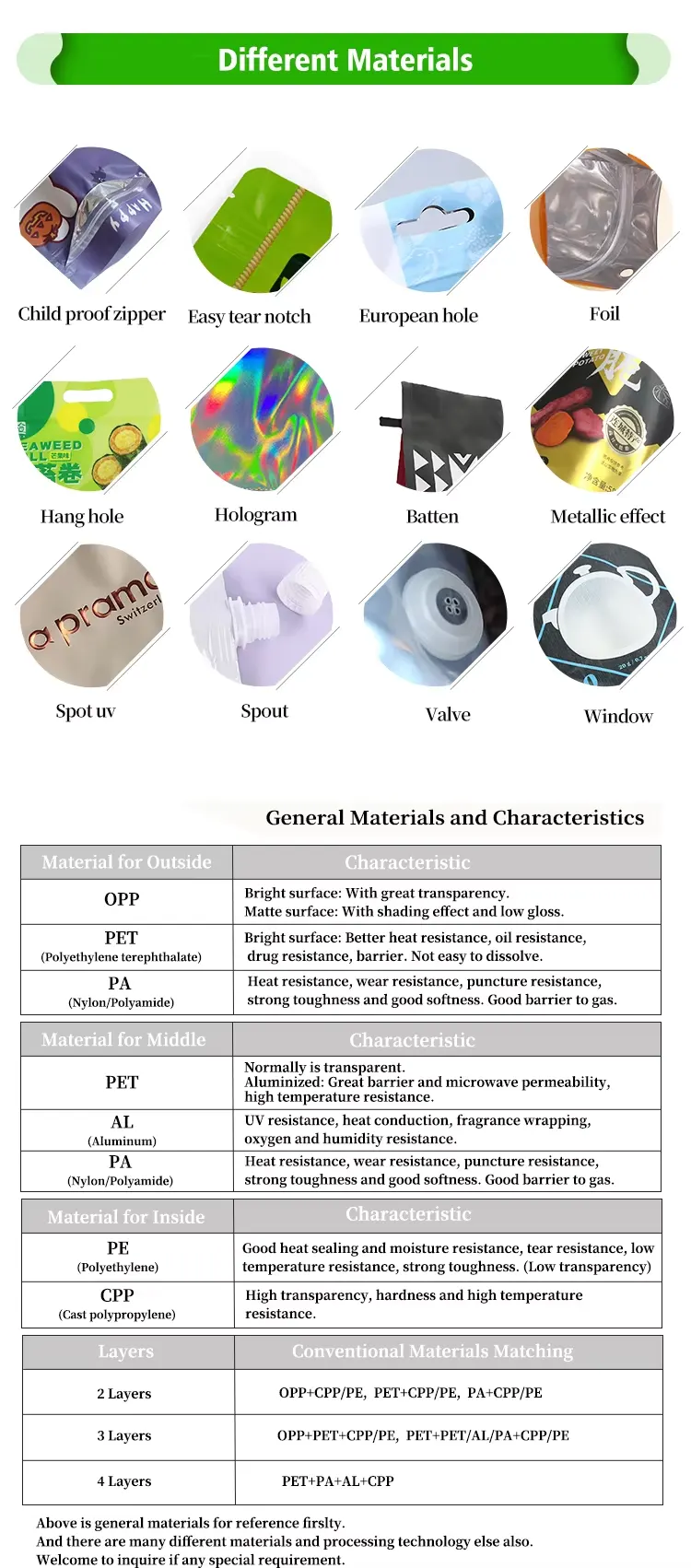
The standard build already includes a press-to-close zipper, a tear notch, a pull tab and rounded edge banding so the outer packaging is not cut by a sharp corner. On top of that, the same pouch can be fitted with a set of functional features:
- One-way valve for degassing
- Child-proof zipper
- Easy-tear notch and European hole
- Hang hole for retail peg display
- Window for product visibility
- Spout for liquids and powders
- Foil, hologram, metallised and batten finishes
- Spot UV for a raised, glossy logo
Printing and Surface Finish
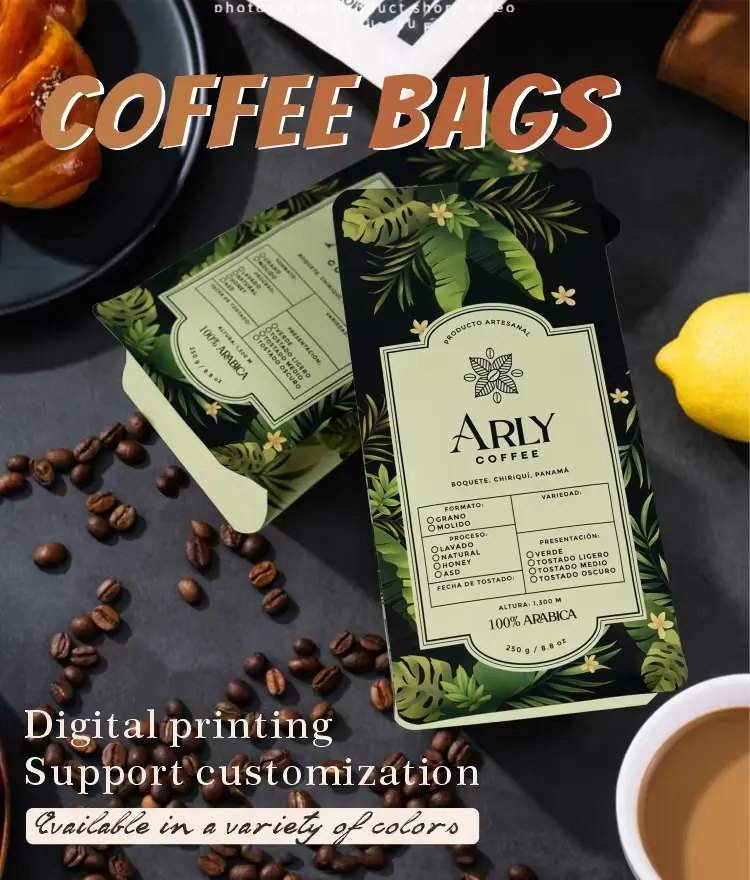
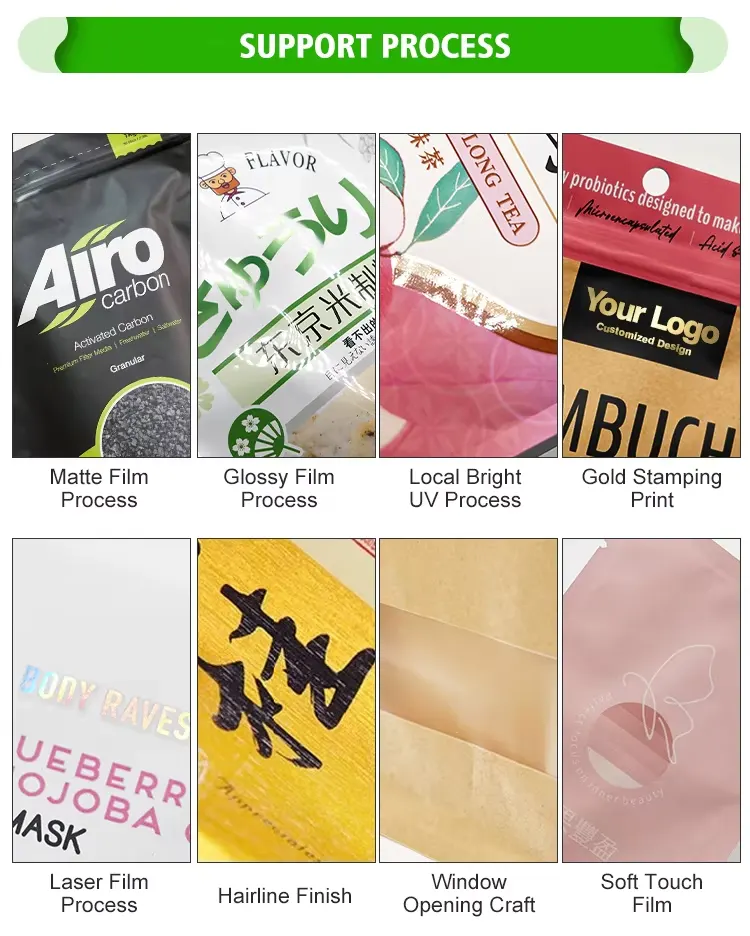
Artwork is printed by digital or gravure process, and the surface finish changes how the pack reads on shelf: matte film for a soft, premium hand feel, glossy film for strong colour, spot UV for a raised logo, gold stamping and laser film for a metallic accent, and soft-touch film for a velvet surface.
Print-ready files are accepted as AI, PDF, PSD, EPS or CDR with text converted to outlines, or as a high-resolution JPG at no less than 300 dpi. Custom designs and colour matching are part of the order, not an add-on.
Sealing the Filled Bag
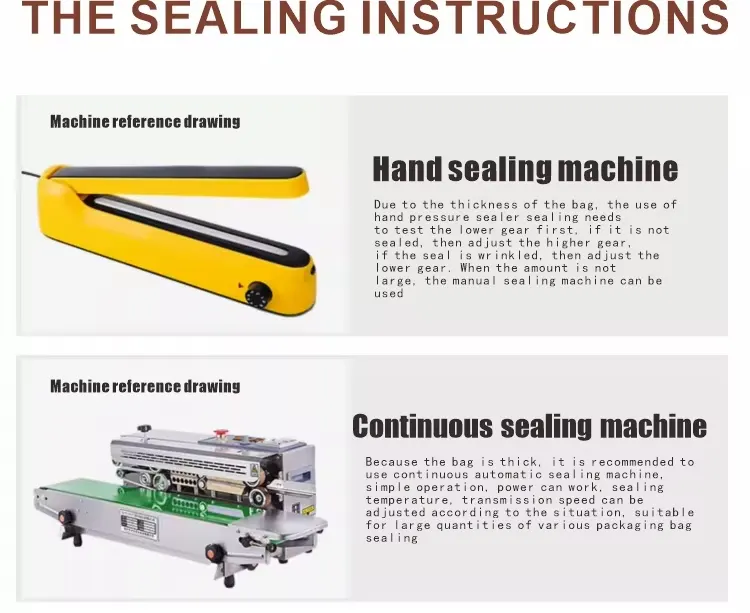
Because the laminate is thicker than a plain PE bag, the sealing method matters. For small runs a hand-pressure sealer is enough: start on the lower power gear, check the seam, and move up a gear if the seal is not closed — or down if the film wrinkles.
For volume production a continuous band sealer is the better match: sealing temperature and conveyor speed are set to the bag thickness, which keeps the seam consistent across a long run.
Where the Bag Is Used
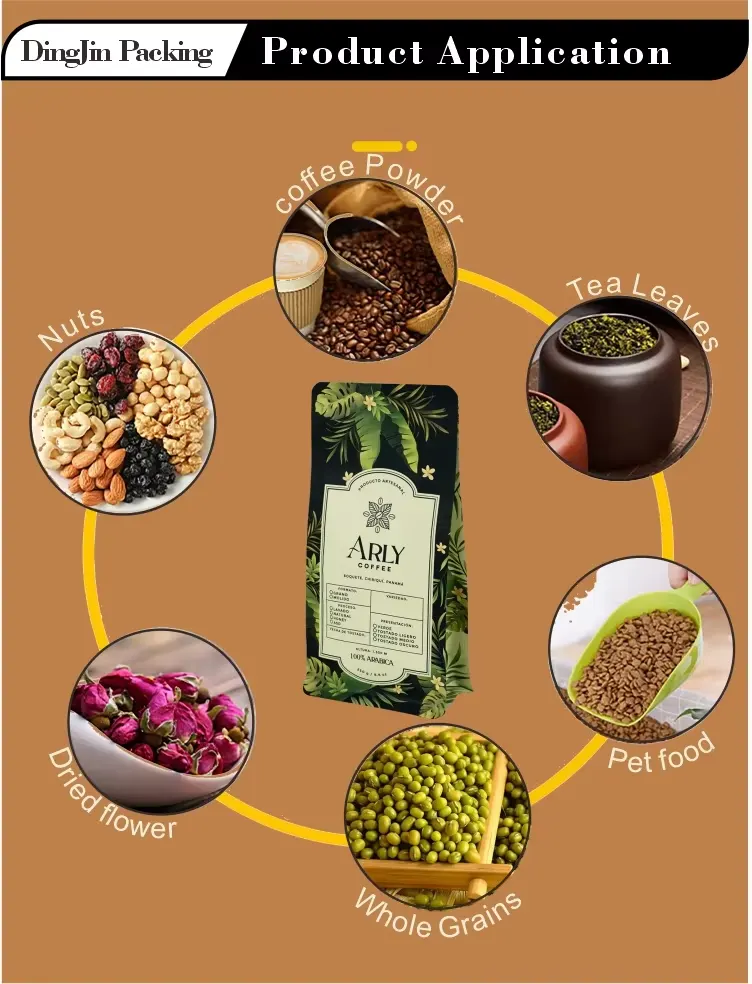
The format suits any dry product that benefits from a standing pack and a resealable top: roasted and ground coffee, tea leaves, nuts, whole grains, dried flowers, pet food and dried fruit.
Ordering
Send the size reference, the fill weight, the material structure and your artwork. We will confirm the valve position, the zipper type and the barrier layer against your shelf-life target, then supply a printed proof and a sealed sample before mass production.